Know who decides. Ask what they will do.
Alameen
10-15-2026
 Email
to a friend Email
to a friend
 Post
a comment Post
a comment
 Print Print
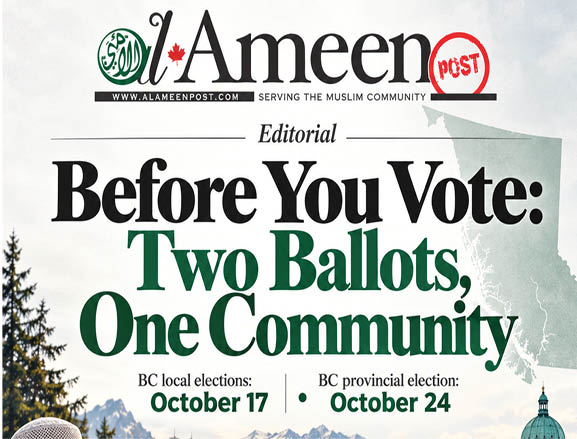
Expect results. Before You Vote: Two Ballots, One Community
British Columbians are heading into two important elections, just eight days apart. On Saturday, October 17, voters will elect their municipal councils and school trustees. A week later, on October 24, they will elect the Members of the Legislative Assembly who will represent them in Victoria.
Two elections, two levels of government, and two opportunities to make our voices heard.
But simply encouraging people to vote is not enough. What matters is whether we understand what we are voting for, what our elected representatives can actually do, and how we intend to hold them accountable afterward.
Too often, political discussions focus on personalities, party affiliations, campaign slogans or promises that sound appealing but fall outside the authority of the office being contested.
A mayor cannot determine Canada’s foreign policy. A school trustee cannot independently rewrite the provincial curriculum. An MLA cannot approve a municipal rezoning application.
Understanding these distinctions matters because accountability begins with knowing who is responsible.
Representation is important. Accountability matters more.
For Canadian Muslims, political participation is not simply about electing more Muslim candidates or gaining recognition during an election campaign.
Representation matters. Having people who understand our experiences, concerns and aspirations at decision-making tables can improve public discussion and access to institutions.
But representation alone is not a guarantee of results.
A Muslim councillor remains one vote among several. A school trustee operates within a board and provincial education framework. An MLA may sit in government or opposition, with very different abilities to influence policy.
We should welcome qualified candidates from our community while judging every candidate, Muslim or otherwise, by the same standards: competence, integrity, accessibility and a willingness to deliver measurable results.
Our political support should never become an unconditional commitment based on someone’s name, faith, ethnicity or political party.
From expressions of concern to practical action
Our community has legitimate concerns about safety, discrimination, education, housing, employment and access to public institutions.
The vandalism and threatening messages directed at Surrey’s Fleetwood Islamic Centre in August were deeply troubling. Police investigated whether hatred was a motivating factor. In Whitehorse, repeated incidents targeting a mosque led to criminal charges against a suspect in September. Those charges remain allegations unless proven in court.
These incidents are reminders that concerns about religious safety are neither abstract nor confined to political speeches.
Statistics Canada’s latest figures show that police reported 4,882 hate crimes nationwide in 2024, including 229 targeting Muslims. British Columbia recorded 692 police-reported hate crimes overall. These figures do not capture every incident experienced or reported through other channels.
Condemning hatred is necessary. But condemnation alone is not a policy.
When candidates promise to address these problems, we should ask what concrete measures they propose. What resources will be available? Which level of government is responsible? How will victims be supported? How will the public know whether conditions have improved?
The same approach should apply to housing affordability, healthcare, school policies and public services.
Our community does not always agree — and that is acceptable
Muslim families, like other British Columbians, hold different views on educational inclusion policies, SOGI 123 resources, political expression in schools, and whether municipal councils should take positions on international conflicts.
These differences deserve respectful discussion rather than assumptions that every Muslim voter thinks alike.
Parents who raise concerns about school policies deserve to be heard. So do students and families seeking protection from discrimination. School boards must explain their policies, follow provincial law and provide fair, accessible complaint procedures.
Similarly, local councils may express positions on international humanitarian issues, but their statements should not be confused with the powers of provincial or federal governments.
We should be able to disagree without abandoning the basic principles of fairness, dignity and equal treatment.
What about our own community institutions?
Elections also provide an opportunity to examine our own responsibilities.
A reader’s letter in our previous issue challenged the BC Muslim Association to become more involved in civic engagement, voter education and support for community participation.
That challenge deserves consideration, and it should extend beyond any one association.
Our mosques, Islamic centres, community organizations and media institutions have an important role in encouraging informed participation in Canadian civic life.
But how consistently are we fulfilling that responsibility?
Are we organizing civic education and voter registration initiatives between elections, or only when an election approaches? Are we inviting candidates from different political backgrounds to community forums? Are we investing in young people who want to serve in public life?
Do our organizations maintain working relationships with elected officials outside moments of crisis? Are we documenting incidents of discrimination, helping affected individuals navigate complaint processes and reporting measurable outcomes?
And perhaps most importantly, are we willing to apply the same standards of transparency and accountability to our own institutions that we demand of government?
Community leadership should not be judged only by public statements, fundraising announcements or photographs with politicians.
It should also be judged by service, accessibility, responsible stewardship and results.
This includes Alameen Post. As a community newspaper, we have a responsibility to ask difficult questions, provide reliable information, welcome differing perspectives and distinguish evidence from opinion.
Voting is the beginning, not the end
We were unable to put all the questions in this election guide directly to candidates before publication. We will not present unanswered questions as though candidates have been consulted.
Instead, we encourage readers to contact candidates directly. Ask specific questions. Request realistic commitments. Keep a record of the answers.
After the elections, revisit those commitments.
The purpose of civic participation should not be to exchange applause during a campaign and disappointment afterward.
It should be to build an informed, engaged community that understands how government works and expects public officials to take their responsibilities seriously.
We are not telling readers which candidate or party to support. Those decisions belong to each voter, guided by their own values, priorities and assessment of the available choices.
But whatever our political preferences, one standard should remain constant:
Respect means listening. Representation means access. Accountability means demonstrating results.
Our responsibility does not end when we mark the ballot. In many ways, that is where it begins.
|