From Online Abuse to Mosque Vandalism
Jafar Bhamji
9-23-2026
 Email
to a friend Email
to a friend
 Post
a comment Post
a comment
 Print Print
Hate in the Lower Mainland: Election-year accountability
As Surrey heads into two elections, candidates should be asked what they will do when hostility toward Muslims moves from screens to community spaces
Sometimes hate arrives through a phone screen. Sometimes it appears on the wall of a mosque.
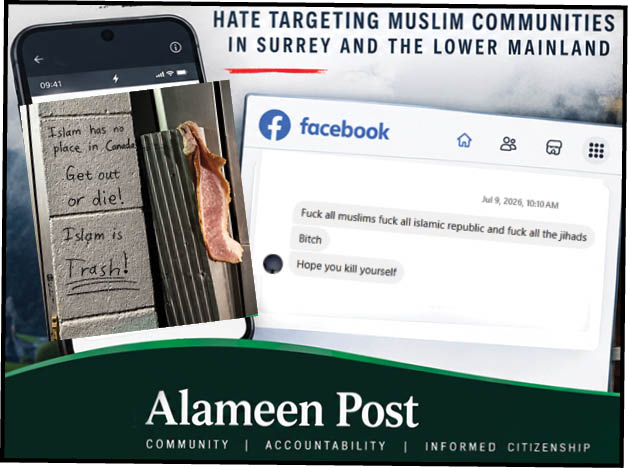
For Alameen Post, the messages came in July.
An unsolicited Facebook Messenger request contained abusive language, hostility toward Muslims and Islam, and a statement encouraging me to take my own life. No attempt was made to contact or independently identify the sender. The account displayed the name “Matt David,” but that name has not been independently verified as the sender’s real identity.
The messages were preserved as they appeared in Facebook Messenger:
“Fuck all muslims fuck all islamic republic and fuck all the jihads”
“Bitch”
“Hope you kill yourself”
There was no response or engagement from Alameen Post. The sender’s identity, location, motive and affiliations remain unknown.
That incident, by itself, does not establish a wider campaign. But it is difficult to dismiss the broader issue when, only weeks later, as Fleetwood Islamic Centre became the target of threatening and offensive graffiti and material believed to be Bacon meat.
From a message to a mosque
On Aug. 29, Surrey police reported investigating an incident at the Fleetwood Islamic Center. Police said threatening and offensive language had been written on the exterior of the building and what was believed to be animal meat had been placed near doors and windows.
Investigators said the incident was believed to have occurred overnight between Aug. 28 and Aug. 29. Police are still determining whether hate was a motivating factor. (Surrey Police)
That distinction matters.
The Fleetwood incident should not be presented as a confirmed hate crime until investigators establish the facts. At the same time, the nature of the reported vandalism and the community setting make it entirely reasonable to ask whether anti-Muslim hostility was involved.
There is currently no evidence establishing a connection between the Messenger incident involving Alameen Post and the Fleetwood incident. They should be treated as separate incidents.
The numbers tell another part of the story
Statistics Canada recorded 4,882 police-reported hate crimes in Canada in 2024, compared with 4,828 in 2023 and 3,612 in 2022.
Of the 2024 total, 1,342 were motivated by religion. Police recorded 229 incidents targeting Muslims, up from 220 in 2023. (Statistics Canada)
“HATE CRIME IN CANADA — THE NUMBERS
•3,612 — 2022
•4,828 — 2023
•4,882 — 2024
•1,342 — religion-motivated, 2024
•229 — targeting Muslims, 2024
•220 — targeting Muslims, 2023
•+4% — increase in Muslim-targeted incidents, 2023–2024
Source: Statistics Canada, 2024 police-reported hate crime data. (Statistics Canada)
Now comes the political question
Surrey voters will go to the polls for the municipal election on Oct. 17, electing a mayor, eight councillors and six school trustees. The B.C. provincial election follows on Oct. 24. (City of Surrey)
That makes this an appropriate time to ask candidates some direct questions.
What will you do when members of a religious community are targeted because of their faith?
What resources should police and community organizations have to respond to threatening incidents?
How quickly should elected officials communicate with affected communities when a mosque, Islamic centre or other religious institution is targeted?
What can municipalities and the province realistically do about online threats that may not meet the threshold of a criminal offence but nevertheless contribute to fear and intimidation?
And perhaps most importantly: what measurable action will you support—not simply what statement will you issue—when this happens again?
Muslim communities should not have to wait for an election campaign to hear politicians condemn hatred. Nor should condemnation be the end of the conversation.
A community newspaper has a responsibility to document what happens. Police have a responsibility to investigate. Elected officials have a responsibility to understand the problem and determine what falls within their jurisdiction.
And candidates seeking public office have an opportunity, during this election cycle, to explain clearly what they believe government can and should do.
The question is no longer simply whether hateful words exist online.
The question is what happens when those words leave the screen—and appear at the door of a place where families gather to pray.
|