When World Cup Hosts Get a Free Pass: Qatar vs. North America
Alameen
6-23-2026
 Email
to a friend Email
to a friend
 Post
a comment Post
a comment
 Print Print
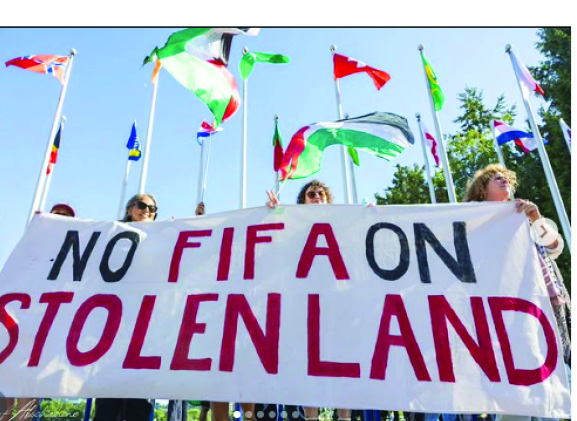
Qatar was made to stand for an entire culture’s shortcomings; if journalists truly care about rights, they must apply the same uncompromising scrutiny to Canada, the United States and Mexico, if rights matter, they must matter everywhere.
World Cup scrutiny should be consistent
The lesson of Qatar 2022 is not that journalists asked too many difficult questions. It is that difficult questions should be asked of every World Cup host nation — including Canada, the United States, and Mexico in 2026. The record so far suggests that Western media were often far harsher in tone toward Qatar, not simply because of genuine rights concerns, but because Qatar was framed through a broader critique of Muslim culture, Arab governance, and non-Western identity.
That does not mean Qatar should have been exempt from scrutiny. Migrant labor abuses, restrictions on LGBTQ+ people, limits on expression, and questions around FIFA’s host-selection process were real and newsworthy. Reuters described “extensive unfavorable media coverage” around labor and human rights, while BBC coverage repeatedly spotlighted foreign-worker treatment and the country’s social restrictions.
Qatar was framed differently
What distinguished Qatar 2022 was not just the volume of criticism, but the style of criticism. Reporting often linked the tournament to Islam, Arab conservatism, and the idea that Qatar was an inherently problematic host. BBC’s Newsround described Qatar as following “strict Muslim laws,” while a 2024 study found that The New York Times framed Qatar through “exotic Otherness” and questioned its legitimacy as a host.
That framing mattered. It meant the World Cup became more than a sporting event; it became a referendum on a Muslim-majority state’s culture, politics, and place in the global order. Even when criticism was grounded in real abuses, the language used often pushed the coverage beyond accountability and into civilizational judgment.
The opening ceremony illustrated that dynamic. BBC chose not to make the ceremony central to its main broadcast, and Al Jazeera reported that pundits on the main telecast discussed human rights instead of airing the inclusivity-themed spectacle. The ceremony was not ignored, but it was subordinated to a critical narrative about the host.
2026 is already different
By contrast, the 2026 World Cup in Canada, the United States, and Mexico is already attracting rights-related scrutiny, but the tone is noticeably different. Reuters has reported on human-rights risks involving U.S. immigration enforcement, protest concerns, and travel restrictions, while Amnesty and Human Rights Watch have warned of risks for fans, journalists, and participants.
This is important because it undercuts any claim that Western media ignore rights problems in their own region. They do not. But they tend to frame them as policy failures, security issues, or administrative problems — not as evidence that North America is culturally unfit to host. That is a very different standard from the one often applied to Qatar.
The examples are concrete. Reuters reported that the United States denied entry to Somali referee Omar Abdulkadir Artan, who had been selected by FIFA and was poised to become the first Somali official at a World Cup. Reuters also reported that Iran’s squad was stuck in visa limbo before its first match and later faced travel restrictions, while Egypt’s request to travel directly to Seattle was denied, forcing logistical changes and longer travel.
The double standard question
These 2026 cases matter because they show how quickly the ideal of a “global celebration” collides with border policy, visa control, and unequal treatment. If a Muslim-majority host receives relentless culture-wide criticism for labor, women’s rights, or social restrictions, then North American hosts should be judged by the same standard when their own systems produce exclusion, delays, or unequal access.
The point is not to excuse Qatar. It is to insist that media standards be applied consistently. If migrant labor conditions, travel restrictions, policing, or rights concerns are serious enough to dominate coverage in Doha, then immigration detention, security screening, and travel barriers in the United States and Mexico should receive comparable editorial attention in 2026.
That comparison is especially relevant for Canadian audiences. Canadian media have a responsibility to avoid reproducing a global hierarchy in which non-Western hosts are treated as suspect by default while Western hosts receive the benefit of softer framing, even when serious rights concerns are documented.
What the evidence shows
The evidence so far supports three points. First, Qatar 2022 was covered with unusually intense moral scrutiny, and that scrutiny often pulled in Islam and Arab identity as explanatory frames. Second, the 2026 tournament is also generating rights-related controversies, but they are being framed more narrowly as governance and security issues. Third, the discrepancy between those two styles of coverage raises a legitimate question about double standards in Western media.
That question does not require a conspiracy theory to be real. Media bias often operates through selection, emphasis, and tone rather than explicit falsehood. In Qatar’s case, the emphasis was frequently on what the country supposedly represented; in North America’s case, the emphasis is more likely to be on what happened operationally.
Conclusion
The lesson of Qatar 2022 is not that journalists should stop asking difficult questions. It is that they should ask them everywhere, and with equal seriousness. If World Cup coverage is to remain credible, then Canada, the United States, and Mexico in 2026 must be judged not only as sporting hosts but as political actors whose security policies, human-rights records, and treatment of outsiders also deserve scrutiny.
A fair media standard would not shield Qatar from criticism. Nor would it shield North America from criticism. It would simply apply the same test to every host: when rights are violated, say so; when culture is relevant, explain it carefully; and when a country is hosting the world, do not confuse geopolitical comfort with journalistic balance.
|