Pakistan, Mastering Triangular Diplomacy Like None Other.
Alameen
4-22-2026
 Email
to a friend Email
to a friend
 Post
a comment Post
a comment
 Print Print
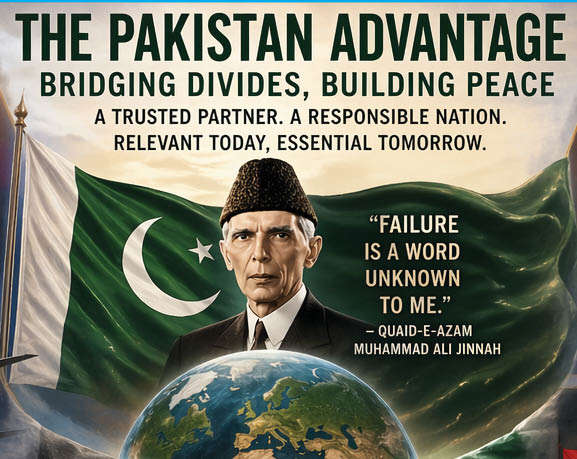
Whether it’s an international cricket ground or an international geopolitical chessboard, one thing is certain, expect the unexpected from Pakistan. Pakistan will surprise you ten out of ten times. Echoing the legacy of its founding father, The Great Leader, Quaid-e-Azam, Mohammed Ali Jinnah, “Failure is a word unknown to me.”
As the international crises of epic proportion hangs over the United Nations. A possibility of World War 3, and even worst, a nuclear catastrophe. One nation has emerged as the saviour, if not ending it. At least, attempting to create a delay – “buying time” – for the rest of the world to breath a sigh of relief, saving the world from the worst possible scenario. That nation is none other than Pakistan.
This is certainly not by fluke. It is rather positing on the goodwill and decades of experience in diplomacy acting as a facilitator by bringing waring factions to settle their dispute through diplomatic channels. Pakistan’s history of “managing” geopolitical issues which primarily, focusses on balancing on major power relationships.
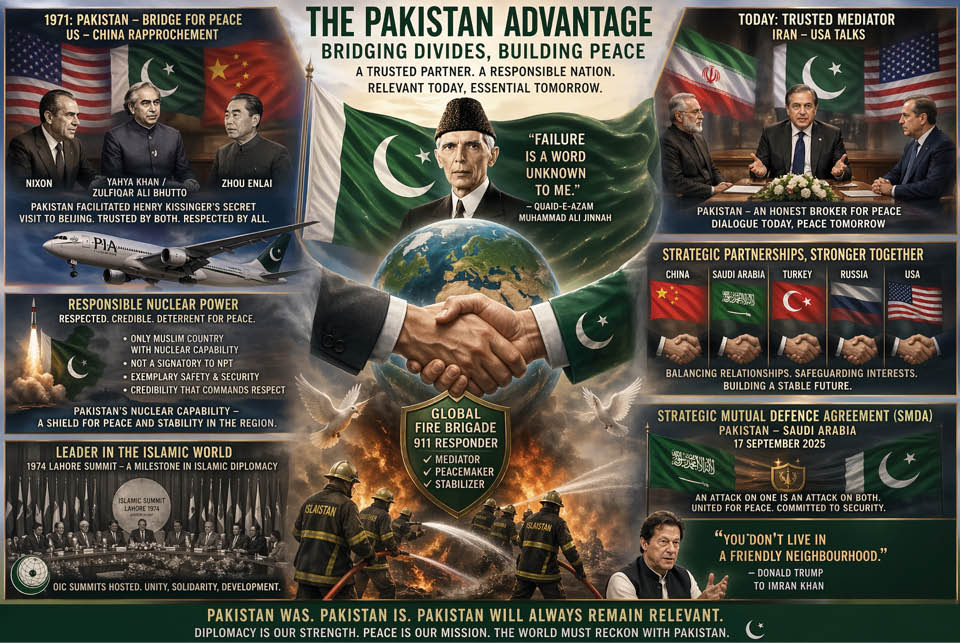
Over the years, Pakistan has certainly mastered the art on maintaining a balancing act between major superpowers, whether it be China, USA, Russia, by developing a trusted relationship with all. Especially, with those neighbouring its borders. It seems, for Pakistan this is more like a survival technique. As President Trump, once quipped to Pakistan’s PM, Imran Khan, “You don’t live in a friendly neighbourhood.”
In 1970’s it was Pakistan’s diplomatic efforts that thawed relationships between Washington and Beijing. “Serving as a bridge for US-China relations in the 1970s and acting as an "ironclad" ally to Beijing, Pakistan has utilized these partnerships to ensure security and economic stability.” It was Pakistan’s Foreign Minister, Mr. Zulfiqar Ali Bhutto and President Yahya Khan aided the Nixon administration in establishing contact with China.
“Pakistan facilitated the 1971 U.S.-China rapprochement by acting as a secret, trusted intermediary, enabling Henry Kissinger's covert visit to Beijing via Islamabad. President Yahya Khan’s government managed communication channels between Washington and Beijing for two years, ultimately providing a private aircraft on July 9, 1971, for Kissinger’s flight to China.” AlJazeera
While on an official visit to Pakistan, Kissinger pretended to be ill, resting in the hills, while he secretly flew on a Pakistani plane from Islamabad to Beijing to meet Zhou Enlai.
Pakistan was trusted by both nations, and this role helped the U.S. open relations with China (initiating the 1972 Nixon visit) while counterbalancing Soviet influence.
Keeping its rival India on its toes, Pakistan has consistently used its partnership with China to counter India’s regional influence and "strategic superiority".
Pakistan played a vital role in regional geopolitical shifts, acting as a crucial regional actor in both the 1971 Indo-Pak war and the Soviet-Afghan war.
Today, Pakistan applies this triangular framework to several regional and global dynamics.
“Currently, China prioritizes Pakistan as a strategic partner to hedge against Indian influence, reinforcing this through economic initiatives like the China-Pakistan Economic Corridor (CPEC).”
Although, the strategy has created a lasting dependence on external powers for security against India. Post-9/11, Pakistan managed a complex balancing act, assisting US interests in Afghanistan while strengthening ties with China.
Being the only Muslim country with nuclear capabilities. Pakistan enjoys a unique position amongst the Muslim nations. Pakistan, PM, Mr. Zulfiqar Ali Bhutto, was not only the first person to present the idea of an “Islamic Bomb.” Pakistan pursued its intended goal and delivered on its promise. That is Pakistan’s unique respectable advantage, amongst Muslim nations. Pakistan is not a signatory to the Non-Proliferation Treaty. Contrary to the world media, especially of Indian propaganda against Pakistan of being the rogue nuclear nation. Pakistan has strictly adhered to international laws in has safeguarding its nuclear assets. Proving its critics, especially India wrong. This have given Pakistan incredible credibility within the international community as a responsible and trusted ally amongst western nations.
While the Organizations of Islamic Countries (OIC) was founded in Rabat, Morocco, in 1969. Pakistan hosted the Second Islamic Summit Conference of the Organisation of Islamic Cooperation (OIC) from February 22-24, 1974, in Lahore. The 1974 Lahore summit is considered a high point in Islamic diplomacy and a key event for the organization, often referred to as the "Second Great Islamic Summit".
Since then, Pakistan has hosted OIC Council of Foreign Ministers (CFM) sessions five times. Additionally, Pakistan has hosted special, extraordinary sessions, including the 17th Extraordinary Session in December 2021 regarding Afghanistan and the Second Extraordinary Islamic Summit in 1997.
On September 17, 2025, Pakistan and Saudi Arabia signed the Strategic Mutual Defence Agreement (SMDA) in Riyadh, creating a formal security pact where any act of aggression against one is treated as an attack on both. This deal strengthens their long-standing partnership, potentially placing a Pakistani "nuclear shield" over the kingdom, formalizing joint military cooperation, and signaling a regional shift away from exclusive dependence on the U.S.
In current geopolitical crises, where both Iran and United States favouring Pakistan as a trusted mediator over other countries such as Turkey and Egypt and completely shunning out India is not a matter of “chance” as some Indian media perpetuates.
It is cemented in the trusted belief by the international community that Pakistan over the years have a proven track record, regardless of who is leading the nation to act as an honest broker.
Pakistan has proven to the world that no matter who might be at the helm of the nation, a democratically elected leader, a military dictator, or a hybrid system, a mixture of the two. Pakistan’s Foreign Ministry and its senior bureaucrats over the past seven decades have established an iron-clad foreign policy that holds the interests of Pakistan, and the Islamic world (OIC) while maintaining a trusted relationship with the international community. It’s a policy, no democratic leader or a military dictator can tinker with.
That’s the Pakistan Advantage. Acting as a Global Fire Brigade Unit – 911 Responder – to put out regional and international fires. Reason for India’s heartburn.
Despite its economic woes, internal political unrests, and constant external threats often instigated in the form of domestic terrorism, by neighbouring India, in hopes of destabilizing the country. Pakistan time and again has established itself a trusted and responsible diplomatic genius, which the world must reckon with. Pakistan was, Pakistan is, and Pakistan will always remain Relevant. The sooner its foes accept that, the sooner they will find relief for their raging heartburn.
|