| |
From 9/11 to a Muslim Mayor of New York
Tarek Ramadan
11-25-2025
 Email
to a friend Email
to a friend
 Post
a comment Post
a comment
 Print Print
Twenty-four years ago, the skyline of New York collapsed in fire and smoke, with it fell the world’s perception of Muslims. Streets once alive with laughter and lights became places of fear and suspicion. Images of Muslim men filled television screens across the United States, Canada, and Europe, and the entire Muslim community was suddenly on trial for terrorism. Women were afraid to walk in public with their headscarves, people hesitated to say their names, and families locked themselves indoors for safety.
It wasn’t only a local tragedy for New York; it became a global turning point, As 9/11, was a tragic event where three thousand people died in one day, it’s yet to be fully investigated as it continues to raise unanswered questions “ Who is really responsible for it? Under President George W. Bush, the United States declared (AUMF) Authorized Use Of Military Force worldwide “war on terror.” Backed with 70 billion dollars from Congress, what followed reshaped entire regions: the invasions of Afghanistan and Iraq, the bombings of Pakistan, Libya, Yemen, Syria, and the tightening of borders and surveillance across the Muslim world. Other nations followed suit, India in Kashmir, Russia in Chechnya, China in Xinjiang, each adopting the same language of “terrorism” to justify repression against Muslim minorities in their countries.
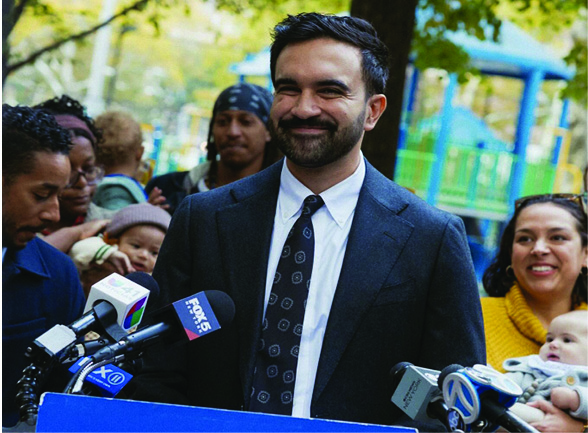
And somewhere in that storm of fear and suspicion, a ten-year-old boy named Zohran Mamdani watched it all unfold. He could never have imagined that one day, the very city that once shrouded his community in doubt would choose a Muslim man to lead it. From the ashes of hate to the heights of leadership, history has turned a page few dared to dream of as we now witness a turning of eras.
It is a day of profound meaning:
It is hard to ignore the timing. On the very day Zohran Mamdani was elected mayor of New York, the same city once scarred by 911, former U.S. Vice President Dick Cheney passed away. For those who lived through that era, Cheney’s name remains bound to the “War on Terror”: to the death of 1.5 million Iraqi citizens and flattening of Afghanistan, to Guantánamo Bay, to Abu Ghraib prison and the secret torture of many who had nothing to do with 9:11.
The point is not to celebrate the passing of Dick Cheney, for every soul return to its Creator. However, the symbolism of that day was unmistakable. For believers, there are no coincidences; every moment unfolds under the will of Allah. As the man whose life was defined by fear, division, greed and warmongering has left this world, a new leader rooted in faith, justice, and service was chosen to guide New York. It felt like history is sending us a reminder: no power lasts forever, and truth and justice, though delayed, always prevail.
a Muslim man now leads the most influential city on the planet. This is a moment that challenges long-held assumptions: that leadership is reserved for the wealthy, the well-connected, or those who conform to dominant cultural narratives. It shows that integrity, service, and faith-driven values can resonate across communities and generations. The implications are profound. For Muslims in America and beyond, this is a reclaiming of dignity after decades of misrepresentation and marginalization. For the political establishment, it is a reminder that the people are watching, learning, and willing to defy old structures. For the world, it is a demonstration that people’s power can allow the most unlikely candidates, those grounded in principle, not privilege, to rise.
Mamdani’s victory also represents a subtle yet seismic shift in cultural consciousness. New Yorkers, by choosing him, are acknowledging that fear and suspicion are not the lenses through which a city or a country should be led. They are saying that justice, empathy, and service are more powerful than prejudice, power, or propaganda. And they are proving that leadership guided by faith, lived through action, and rooted in community can be a model to follow in the modern world.
A Lesson for the World
Zohran Mamdani’s election is more than a local milestone; it is a message to the rest of America, and perhaps to the wider Western world. It is a reminder that people of faith, especially Muslims, should not be judged by prejudice or fear. Muslims carry a framework of values that guides their lives: justice, service, honesty, and commitment to their communities. A Muslim leader migrating or a citizen of a country, respects the law, treats everyone fairly, and works for the benefit of all even those who oppose him.
New York has shown what can happen when a society judges’ people by their character and contributions, rather than their faith or background. This is a lesson Europe, with its growing Muslim populations in England, France, Germany, and the Netherlands, can take to heart. Educated Muslims, politicians, thinkers, teachers, and working professionals can help solve society’s most pressing problems with sincerity and dedication. Mamdani’s leadership demonstrates that faith, integrity, and action are not obstacles but strengths in guiding a diverse, modern city.
In this turning point, there is hope: that Western societies may begin to see Muslims in positions of leadership not as outsiders, but as partners in building justice, fairness, and a better future for all.
|